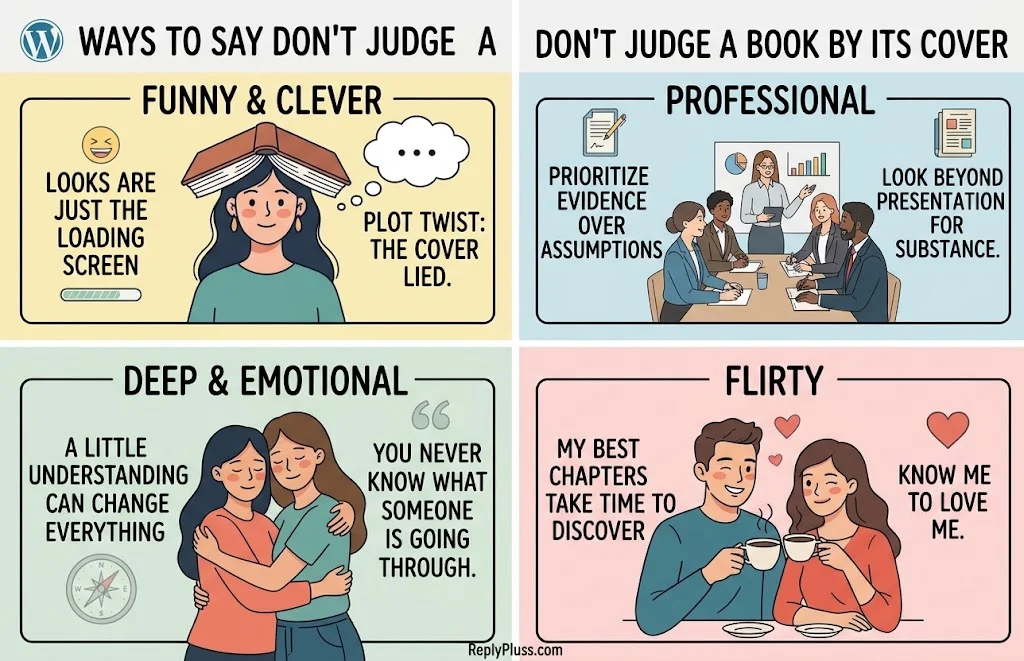
Looking for ways to say “don’t judge a book by its cover” without using the same old phrase? These alternatives help you express the idea naturally in conversations, texts, captions, and professional settings.
That’s exactly why the saying “don’t judge a book by its cover” still matters. First impressions happen fast, whether you’re meeting someone new, chatting with a crush, scrolling through social media, or working with a new colleague.
From clever one-liners to thoughtful expressions, you’ll find options for texts, DMs, captions, friendships, and workplace conversations. Use them to challenge assumptions, encourage kindness, or remind someone that appearances never tell the whole story. After all, the cover might catch your attention, but the story is what counts.
1. Funny Ways to Say Don’t Judge a Book by Its Cover
Want to make your point without turning the conversation into a motivational seminar? These funny alternatives keep things light while reminding people that appearances can be misleading.
- Looks can be seriously misleading. Use this when someone’s first impression turns out to be completely wrong.
Meaning: Appearances do not always reflect reality. - Don’t rate the movie by its poster. Use this when someone dismisses a film or person too quickly.
Meaning: Give something a fair chance before deciding. - The packaging isn’t the whole product. Use this when someone focuses too much on appearances.
Meaning: What’s inside matters more than presentation. - Plot twist: the cover lied. Use this when someone surprises everyone with their real personality.
Meaning: First impressions can be unexpectedly inaccurate. - Cute cover, complicated chapters. Use this for a playful caption about someone with hidden depth.
Meaning: People are more complex than they initially appear. - Don’t judge the Wi-Fi by the router. Use this when you want a silly comparison in a casual chat.
Meaning: The outside doesn’t tell you everything about performance. - The trailer doesn’t reveal the whole movie. Use this when someone makes assumptions after a brief introduction.
Meaning: A small preview cannot explain the entire story. - Looks are just the loading screen. Use this in a meme or conversation about first impressions.
Meaning: The real experience goes beyond appearances. - Don’t review the book after seeing the spine. Use this when someone forms an opinion without enough information.
Meaning: A fair judgment requires more than a glance. - The cover has entered the chat, but the plot hasn’t. Use this as a witty social media caption.
Meaning: Appearance is only one small part of the story. - Never judge a snack by its wrapper. Use this when someone overlooks an unexpectedly good experience.
Meaning: Presentation doesn’t determine quality. - The outside is the trailer, not the season finale. Use this when reminding friends to get to know someone first.
Meaning: A first impression cannot reveal everything.
2. Clever Ways to Say Don’t Judge a Book by Its Cover
These thoughtful alternatives sound smart without trying too hard. They’re ideal for meaningful conversations, captions, essays, or moments when you want your words to stick.
- There’s more than meets the eye. Use this when someone has qualities that aren’t immediately obvious.
Meaning: People often have hidden depth. - Look beyond the surface. Use this when encouraging someone to explore a situation more carefully.
Meaning: Deeper understanding requires more than appearances. - Appearances tell only half the story. Use this when someone reaches a conclusion too quickly.
Meaning: Visible details rarely provide the complete picture. - First impressions aren’t final verdicts. Use this when someone needs a reminder to stay open-minded.
Meaning: Initial opinions should remain open to revision. - The outside reveals little about the inside. Use this in a reflective discussion about character.
Meaning: External appearance cannot reliably reveal inner qualities. - A glance isn’t an understanding. Use this when someone assumes they know a person after one meeting.
Meaning: Understanding requires time and attention. - Character goes deeper than appearance. Use this when discussing someone’s values or personality.
Meaning: Personal qualities matter more than looks. - The story matters more than the cover. Use this in a caption about personal growth or identity.
Meaning: Experiences and character define a person more fully. - Don’t confuse presentation with substance. Use this in professional or academic discussions.
Meaning: Attractive presentation does not guarantee genuine quality. - A surface impression is only a starting point. Use this when encouraging a more balanced opinion.
Meaning: Initial observations should lead to further understanding. - Depth can’t always be seen at first sight. Use this when praising someone’s hidden talents or wisdom.
Meaning: Valuable qualities may take time to discover. - Understanding begins where assumptions end. Use this during a conversation about fairness or prejudice.
Meaning: Open-mindedness helps people understand one another.
3. Short and Simple Alternatives
Sometimes a quick line says everything. These concise alternatives work well in texts, comments, captions, and everyday conversations.
- Never judge by looks alone. Use this when correcting a snap judgment.
Meaning: Appearance should not be the only basis for an opinion. - Looks aren’t everything. Use this during a casual conversation about attractiveness.
Meaning: Other qualities matter just as much or more. - There’s more to everyone. Use this when reminding someone that people have hidden sides.
Meaning: Every person has qualities beyond what is immediately visible. - Don’t judge too soon. Use this when someone forms an opinion after a brief encounter.
Meaning: Wait for more information before deciding. - Look a little deeper. Use this when encouraging someone to explore beyond appearances.
Meaning: Seek a fuller understanding. - The surface isn’t the story. Use this as a short caption about personal identity.
Meaning: Outward appearances don’t tell the whole truth. - Give people a chance. Use this when someone dismisses another person without getting to know them.
Meaning: Allow others an opportunity to show who they are. - Looks can fool you. Use this in an informal conversation about surprising first impressions.
Meaning: Appearance can create inaccurate expectations. - Don’t assume too much. Use this when someone jumps to conclusions.
Meaning: Avoid conclusions that go beyond the available evidence. - See beyond appearances. Use this when encouraging empathy and understanding.
Meaning: Focus on qualities beyond outward presentation. - Everyone has a story. Use this when discussing people whose lives aren’t obvious.
Meaning: Each person has experiences that others may not know. - Wait for the real picture. Use this when someone needs more context before deciding.
Meaning: Gather enough information to make a fair judgment.
4. Polite Ways to Say Don’t Judge a Book by Its Cover
When you want to correct someone’s assumptions without sounding rude, these gentle alternatives make your point with respect.
- Perhaps we should get to know them first. Use this when a group judges a newcomer too quickly.
Meaning: Understanding should come before judgment. - There’s probably more to the story. Use this when discussing an unfamiliar person or situation.
Meaning: Additional context may change the initial impression. - Let’s keep an open mind. Use this when people disagree about someone they barely know.
Meaning: Remain willing to consider different possibilities. - We shouldn’t judge too quickly. Use this when encouraging fairness in a discussion.
Meaning: Give yourself time to understand before deciding. - Appearances don’t always tell us everything. Use this when gently challenging someone’s assumption.
Meaning: Visible details may leave out important information. - Everyone deserves a fair chance. Use this when someone is being excluded based on appearance.
Meaning: People should have an opportunity to show their qualities. - Let’s give them the benefit of the doubt. Use this when someone’s behavior has been misunderstood.
Meaning: Avoid assuming the worst without sufficient evidence. - It may be worth looking a little deeper. Use this during a thoughtful conversation about first impressions.
Meaning: More information may lead to a better understanding. - We may not know the full picture yet. Use this when a situation remains unclear.
Meaning: A final judgment would be premature. - It’s best to understand before we conclude. Use this when encouraging a more careful approach.
Meaning: Understanding should precede judgment. - People can surprise us in wonderful ways. Use this when someone seems different from expectations.
Meaning: People may possess unexpected positive qualities. - Let’s focus on who they are, not just how they look. Use this when discussing unfair assumptions.
Meaning: Character deserves more attention than appearance.
5. Professional Ways to Say Don’t Judge a Book by Its Cover
In the workplace, the message is often about fairness, evidence, and avoiding assumptions. These alternatives suit meetings, emails, interviews, and professional discussions.
- Evaluate people based on their abilities and conduct. Use this during a discussion about hiring or teamwork.
Meaning: Professional judgment should rely on relevant qualities. - First impressions should not replace objective assessment. Use this when discussing candidate evaluations.
Meaning: Decisions should be based on evidence rather than initial reactions. - Look beyond presentation to assess substance. Use this when reviewing a proposal or presentation.
Meaning: Quality matters more than outward polish. - A fair assessment requires adequate information. Use this when a decision seems premature.
Meaning: Reliable judgments need sufficient evidence. - Let’s avoid assumptions and consider the facts. Use this during a workplace disagreement.
Meaning: Decisions should reflect evidence rather than speculation. - Professional capability isn’t always immediately visible. Use this when advocating for an overlooked colleague.
Meaning: Skills may not be obvious at first glance. - Let’s assess the individual on their merits. Use this during recruitment or performance reviews.
Meaning: Evaluate relevant strengths and qualifications fairly. - Initial impressions should be treated as provisional. Use this in a formal discussion about decision-making.
Meaning: Early opinions may change with new evidence. - Appearance alone is not a reliable measure of competence. Use this when discussing professional suitability.
Meaning: Skills and performance are better indicators of competence. - We should consider the broader context. Use this when a decision depends on incomplete information.
Meaning: Context helps prevent misleading conclusions. - Let’s prioritize evidence over assumptions. Use this when reviewing a proposal or employee’s work.
Meaning: Objective information should guide evaluation. - A comprehensive evaluation goes beyond first impressions. Use this in formal reports or meetings.
Meaning: Fair assessment considers multiple relevant factors.
6. Funny and Sarcastic Alternatives
Need a little attitude without being unnecessarily mean? These sarcastic lines challenge snap judgments while keeping the conversation entertaining.
- Oh, did you read the entire book from the cover? Use this when someone acts as though they know everything about a stranger.
Meaning: Their conclusion is based on very limited information. - Congratulations on your five-second investigation. Use this when a friend makes an instant judgment.
Meaning: A quick glance is not enough to understand someone. - The detective work is impressive, Sherlock. Use this in a playful exchange about assumptions.
Meaning: The other person is acting overly certain without enough evidence. - Wow, the cover really told you everything, huh? Use this when someone judges a person by appearance.
Meaning: Their confidence is greater than their knowledge. - Let’s not write the review before reading the book. Use this when someone criticizes something they haven’t experienced.
Meaning: A fair opinion requires firsthand understanding. - That’s a bold conclusion for such little information. Use this when someone jumps to an unsupported opinion.
Meaning: The judgment is premature. - The plot hasn’t even started yet. Use this when someone dismisses a person too quickly.
Meaning: There’s much more to discover. - A little less assuming, a little more knowing. Use this when encouraging someone to check the facts.
Meaning: Knowledge is more useful than speculation. - You saw the cover and skipped the entire story. Use this when someone overlooks important details.
Meaning: Their opinion ignores the bigger picture. - Not every mystery is solved by looking at the cover. Use this during a humorous debate about first impressions.
Meaning: Some things require patience and deeper investigation. - That opinion came with a very short research period. Use this when someone makes a snap judgment.
Meaning: Their conclusion lacks sufficient investigation. - Maybe read a chapter before writing the review. Use this when someone needs a gentle but witty correction.
Meaning: Experience should come before evaluation.
7. Flirty Ways to Say Don’t Judge a Book by Its Cover
When attraction enters the chat, a little mystery can make the conversation more interesting. These playful lines work for crushes, dating apps, and lighthearted flirting.
- There’s more to me than meets the eye. Use this when a crush says you seem mysterious.
Meaning: You have qualities that aren’t immediately obvious. - You’ll have to get to know me to find out. Use this when someone seems curious about your personality.
Meaning: You’re inviting them to discover more about you. - The cover is cute, but the story is better. Use this when flirting with someone who compliments your appearance.
Meaning: Your personality is worth discovering too. - Don’t judge the book until you’ve read a chapter. Use this when teasing someone who has made assumptions about you.
Meaning: Give yourself a chance to make a deeper impression. - My best chapters take time to discover. Use this when you want to sound intriguing without overdoing it.
Meaning: Your deeper qualities emerge with familiarity. - Looks got your attention; personality might keep it. Use this when playfully responding to a compliment.
Meaning: Attraction becomes more meaningful through connection. - There’s a whole plot twist waiting for you. Use this when a crush thinks they already have you figured out.
Meaning: You may surprise them as they get to know you. - The real charm comes with the chapters. Use this in a playful conversation about attraction.
Meaning: Personality adds depth to physical appeal. - Don’t skip the story just because you like the cover. Use this when encouraging a crush to look beyond appearances.
Meaning: A genuine connection requires more than attraction. - You might like the story even more than the cover. Use this when someone shows interest in getting to know you.
Meaning: Your personality could deepen their attraction. - The outside is the introduction, not the entire book. Use this when explaining that you have more to offer than looks.
Meaning: Your outward appearance is only one part of your identity. - Stick around; the best parts aren’t on the cover. Use this when playfully inviting someone to know you better.
Meaning: You’re suggesting that a deeper connection could be rewarding.
8. Deep and Thoughtful Alternatives
For meaningful conversations about empathy, identity, and human nature, these expressions communicate the message with depth.
- Every face carries a story we may never see. Use this when discussing empathy or human experiences.
Meaning: People have private experiences that shape who they are. - The human heart is more complex than appearances suggest. Use this in a reflective conversation about relationships.
Meaning: Emotions and character cannot be understood through looks alone. - Understanding someone takes more than observation. Use this when encouraging a friend to listen before judging.
Meaning: Genuine understanding requires attention and interaction. - People are deeper than their first impression. Use this when talking about personal identity.
Meaning: A brief encounter cannot capture someone’s full personality. - Compassion begins when judgment slows down. Use this during a discussion about empathy.
Meaning: Patience helps create room for understanding. - The unseen parts often explain the visible ones. Use this when someone’s behavior needs context.
Meaning: Hidden experiences may help explain outward actions. - A person’s worth isn’t written on their appearance. Use this when challenging superficial standards.
Meaning: Human value is not determined by looks. - Every individual deserves to be understood beyond assumptions. Use this when advocating for fairness.
Meaning: People should be considered as individuals rather than stereotypes. - The surface is only one layer of a person. Use this when discussing the complexity of identity.
Meaning: Personality contains many qualities beyond appearance. - Wisdom means questioning your first impression. Use this when reflecting on personal growth.
Meaning: Mature judgment includes reconsidering initial beliefs. - What we see is not always what someone carries inside. Use this when encouraging sensitivity toward others.
Meaning: Outward appearances may conceal emotions or struggles. - True understanding begins with curiosity, not conclusions. Use this when encouraging open-minded conversations.
Meaning: Asking questions is more productive than making assumptions.
9. Creative Ways to Say Don’t Judge a Book by Its Cover
If you want a fresh expression instead of a familiar proverb, these imaginative alternatives add personality to your writing and conversations.
- Don’t measure the ocean by its shoreline. Use this when describing someone with unexpected depth.
Meaning: A small visible part cannot reveal the whole. - The wrapper isn’t the recipe. Use this when explaining why appearance doesn’t determine quality.
Meaning: Presentation and substance are different things. - Don’t judge the song by its album art. Use this when discussing music or creative work.
Meaning: The experience matters more than the packaging. - Every door hides a room you haven’t seen. Use this when discussing unexplored possibilities.
Meaning: There’s more beyond the first thing you notice. - The first page isn’t the whole library. Use this when describing someone’s many talents.
Meaning: One small impression cannot represent an entire person. - Don’t mistake the frame for the painting. Use this in a thoughtful conversation about appearances.
Meaning: The outer presentation isn’t the real substance. - A seed doesn’t reveal the entire garden. Use this when encouraging patience with someone’s development.
Meaning: Potential takes time to become visible. - The map isn’t the destination. Use this when discussing the difference between expectations and reality.
Meaning: An initial representation cannot replace the full experience. - Don’t judge the sunrise by the darkness before it. Use this when someone underestimates a difficult beginning.
Meaning: Initial circumstances don’t determine the final outcome. - The melody matters more than the album sleeve. Use this when discussing creative talent.
Meaning: The actual qualities of something matter more than its appearance. - A window shows a view, not the whole house. Use this when reminding someone that their perspective is limited.
Meaning: What you can see is only part of the larger picture. - The best discoveries rarely fit on the label. Use this when describing unexpected talents or qualities.
Meaning: Valuable qualities often go beyond simple descriptions.
10. Cute Ways to Say Don’t Judge a Book by Its Cover
These gentle, charming alternatives are ideal for friendly messages, uplifting captions, and conversations where kindness is the main goal.
- Give the story a little chance to bloom. Use this when encouraging someone to get to know a new friend.
Meaning: Good qualities may appear with time. - There’s a little magic beneath the surface. Use this when describing someone with a lovely personality.
Meaning: People can possess wonderful qualities that aren’t immediately visible. - Every book has its own kind of sparkle. Use this when celebrating individuality.
Meaning: Everyone has unique qualities worth appreciating. - Don’t miss a lovely story because of its cover. Use this when someone dismisses a person too quickly.
Meaning: A superficial judgment can hide something wonderful. - Give kindness a chance to surprise you. Use this when encouraging someone to approach others warmly.
Meaning: Open-mindedness can lead to positive discoveries. - Little covers can hold big adventures. Use this when describing something unexpectedly impressive.
Meaning: Appearance doesn’t determine potential. - The sweetest stories take time to unfold. Use this when discussing new friendships or relationships.
Meaning: Meaningful connections develop gradually. - There’s more sunshine beneath the surface. Use this when describing someone’s hidden warmth.
Meaning: A person may be kinder or more positive than they first appear. - Let the heart tell the story. Use this when encouraging someone to focus on kindness.
Meaning: Inner qualities deserve attention. - Every person deserves a little understanding. Use this when promoting compassion in a group.
Meaning: People deserve patience before being judged. - Sometimes the quietest covers hold the brightest stories. Use this when celebrating a shy or overlooked person.
Meaning: Quiet individuals can have remarkable personalities. - Look for the little wonders, not just the wrapping. Use this when encouraging appreciation beyond appearances.
Meaning: Small but meaningful qualities matter more than presentation.
11. Confident Ways to Say Don’t Judge a Book by Its Cover
These self-assured expressions help you stand up for yourself or someone else without sounding defensive.
- You don’t know the whole story yet. Use this when someone makes assumptions about your personality.
Meaning: Their current understanding is incomplete. - My appearance doesn’t define my character. Use this when someone focuses too much on how you look.
Meaning: Your values and behavior matter more than your appearance. - Get to know me before deciding who I am. Use this when someone forms a premature opinion.
Meaning: You expect to be judged on more than a first impression. - I prefer facts over assumptions. Use this during a disagreement about your abilities.
Meaning: You value evidence rather than speculation. - There’s more to me than what you see. Use this when you want to assert your individuality.
Meaning: Your visible traits don’t capture your entire identity. - Judge my actions, not my appearance. Use this when asking someone to assess you fairly.
Meaning: Conduct is a more meaningful basis for judgment. - I’m more than a first impression. Use this when someone misunderstands you after a brief encounter.
Meaning: Your personality deserves a deeper look. - Don’t mistake what you see for all that I am. Use this when explaining that you have hidden strengths.
Meaning: Your identity is more complex than it appears. - Let my character speak for itself. Use this when you want your actions to demonstrate your values.
Meaning: You believe behavior reveals more than appearances. - I deserve the same fair chance as anyone else. Use this when facing unfair assumptions.
Meaning: You expect to be treated with equal consideration. - Your first impression doesn’t have to be your final opinion. Use this when inviting someone to reconsider their judgment.
Meaning: People can change their minds as they learn more. - Know the person before you label the person. Use this when challenging stereotypes or quick judgments.
Meaning: Individual understanding should come before labeling.
12. Emotional Ways to Say Don’t Judge a Book by Its Cover
Sometimes this message comes from a personal place. These expressions work when you want someone to recognize the feelings or experiences they may not see.
- You never know what someone is going through. Use this when encouraging compassion toward a struggling person.
Meaning: Private difficulties may not be visible. - Not every smile tells the whole story. Use this when discussing the emotions behind someone’s outward appearance.
Meaning: People may feel differently from how they appear. - Some wounds aren’t visible to the eye. Use this when explaining why empathy matters.
Meaning: Emotional pain may be hidden from others. - Please understand before you assume. Use this when someone has misunderstood your actions.
Meaning: You want to be heard before being judged. - There’s a reason behind every story. Use this when someone’s behavior needs more context.
Meaning: Experiences can shape people’s choices and reactions. - You see my outside, not everything I’ve lived through. Use this when explaining that your experiences aren’t obvious.
Meaning: Your life story is more complicated than it looks. - Sometimes the strongest people carry the heaviest stories. Use this when appreciating someone’s resilience.
Meaning: Strength can coexist with hidden struggles. - A little understanding can change everything. Use this when encouraging someone to approach a situation with empathy.
Meaning: Compassion can transform how people interpret others. - Don’t let assumptions silence someone’s story. Use this when someone is being misunderstood.
Meaning: People should have the opportunity to explain themselves. - Behind every face is a life you don’t fully know. Use this when promoting empathy in a group discussion.
Meaning: Everyone has experiences beyond what others can see. - Give people room to be more than their worst moment. Use this when someone is being defined by a single mistake.
Meaning: One action does not necessarily represent an entire person. - Understanding someone is an act of kindness. Use this when encouraging a friend to listen without judging.
Meaning: Empathy helps people feel seen and respected.
13. Social Media Caption Alternatives
Looking for a short caption for Instagram, TikTok, Facebook, or Pinterest? These lines make the message memorable without sounding like a lecture.
- The cover is cute, but the story hits different. Use this with a photo that shows your personality.
Meaning: Your deeper qualities matter more than your appearance. - First impressions are just the opening scene. Use this with a reflective selfie or video.
Meaning: Initial encounters don’t reveal everything. - More chapters, fewer assumptions. Use this as a short caption about personal growth.
Meaning: Get to know people before judging them. - Not everything is as it appears. Use this when sharing a surprising experience.
Meaning: Reality may differ from appearances. - Look deeper, judge less. Use this on a kindness-themed post.
Meaning: Understanding deserves more attention than criticism. - The plot is always bigger than the cover. Use this with a photo that reflects your individuality.
Meaning: Every person has a story beyond appearances. - Beyond the surface lies the story. Use this with an inspirational image.
Meaning: Deeper qualities reveal a fuller picture. - Don’t scroll past the story. Use this when encouraging followers to look beyond a profile picture.
Meaning: Online appearances don’t capture a whole person. - Character is the real aesthetic. Use this with a post about values and kindness.
Meaning: Personality and behavior matter more than looks. - The best parts aren’t always visible. Use this with a personal or friendship post.
Meaning: Some of the most valuable qualities are hidden. - Read people with an open mind. Use this on a thoughtful social media post.
Meaning: Approach others without premature assumptions. - Every person deserves more than a preview. Use this when promoting empathy and acceptance.
Meaning: People deserve to be understood beyond first impressions.
14. Wise and Inspirational Alternatives
These expressions suit motivational posts, personal reflections, classroom discussions, and messages about treating people fairly.
- Kindness begins when we look beyond appearances. Use this in an inspirational post about compassion.
Meaning: Understanding others encourages kinder behavior. - Never let a first impression close the door to understanding. Use this when encouraging open-mindedness.
Meaning: Initial opinions should not prevent further discovery. - The value of a person cannot be measured by appearance. Use this when discussing dignity and equality.
Meaning: Every person has worth beyond their looks. - A fair mind looks beyond the obvious. Use this when discussing thoughtful decision-making.
Meaning: Fair judgment considers more than visible details. - Wisdom asks questions before reaching conclusions. Use this in a reflective caption or discussion.
Meaning: Curiosity helps prevent premature judgment. - See the person, not the stereotype. Use this when challenging generalizations about groups.
Meaning: Individuals deserve to be understood on their own merits. - True character reveals itself through actions. Use this when explaining what makes someone trustworthy.
Meaning: Behavior is a stronger indicator of character than appearance. - An open mind discovers what a closed mind misses. Use this when encouraging people to reconsider their assumptions.
Meaning: Openness makes room for new understanding. - Every story deserves to be heard before it’s judged. Use this when promoting fairness in a disagreement.
Meaning: Listening is essential to understanding. - Look for truth beyond the first impression. Use this when someone has formed an opinion too quickly.
Meaning: Deeper investigation can reveal a more accurate picture. - Respect begins where superficial judgment ends. Use this in a message about inclusion and dignity.
Meaning: Fair treatment requires looking beyond appearances. - The more we understand, the less we assume. Use this as a reflective caption about personal growth.
Meaning: Knowledge helps replace assumptions with understanding.
15. Alternative Proverbs and Idioms
Want an established expression rather than a newly written one? These familiar sayings and idioms communicate similar ideas, although some focus on different aspects of judgment.
- Appearances can be deceiving. Use this when something or someone turns out differently than expected.
Meaning: What you see may not reflect reality. - Beauty is only skin-deep. Use this when discussing why inner qualities matter more than attractiveness.
Meaning: Physical beauty does not reveal a person’s deeper worth. - All that glitters is not gold. Use this when something looks impressive but may lack real value.
Meaning: Attractive appearances can hide shortcomings. - Never judge a person by their appearance. Use this when emphasizing fair treatment.
Meaning: A person’s looks should not determine their worth. - Don’t judge a person until you’ve walked a mile in their shoes. Use this when encouraging empathy.
Meaning: Understanding another person’s experience helps prevent unfair judgment. - Things are not always what they seem. Use this when a situation has unexpected details.
Meaning: Appearances can create a misleading impression. - The devil is in the details. Use this when a closer examination reveals important complications.
Meaning: Small details can change how something should be understood. - Still waters run deep. Use this when describing someone quiet who has considerable depth.
Meaning: A calm exterior can conceal rich thoughts or abilities. - Don’t count your chickens before they hatch. Use this when someone assumes an outcome before it happens.
Meaning: Avoid treating uncertain expectations as facts. - Never judge a journey by its first step. Use this when someone’s early progress seems unimpressive.
Meaning: A beginning does not determine the entire outcome. - You can’t tell a tree’s strength by its bark alone. Use this as a nature-inspired way to discuss hidden qualities.
Meaning: External appearance does not reveal the full strength of something. - The proof is in the pudding. Use this when someone needs to see actual results before deciding.
Meaning: Real value is demonstrated through experience or results.
FAQs About Ways to Say Don’t Judge a Book by Its Cover
What Does “Don’t Judge a Book by Its Cover” Mean?
It means you shouldn’t judge someone or something based only on appearance.
What Is Another Way to Say “Don’t Judge a Book by Its Cover”?
Try “Appearances can be deceiving” or “There’s more than meets the eye.”
Can the Phrase Have a Flirty Meaning?
Yes. It can suggest that someone should get to know you beyond your looks.
How Do You Say It Professionally?
Say, “First impressions should not replace an objective assessment.”
What If You Don’t Mean the Phrase Literally?
Use “Look beyond the surface” to discuss personality, quality, or hidden potential.
Is Humor Appropriate When Saying It?
Yes. Funny lines work well with friends, provided they don’t embarrass or insult anyone.
What Is a Short Alternative to the Phrase?
“Never judge by looks alone” is a simple, clear alternative.
Is It Rude to Tell Someone Not to Judge?
Not necessarily. A calm, respectful explanation can challenge assumptions without causing offense.
Conclusion
The right words can turn an ordinary conversation into a moment that changes someone’s perspective. Whether you prefer a funny comeback, a thoughtful expression, a flirty line, or a professional alternative, these ways to say don’t judge a book by its cover give you plenty of options for different situations. Remember, the goal isn’t to stop people from forming first impressions altogether.
It’s to encourage them to stay curious, fair, and open to learning more. Try a few expressions in your next conversation, save your favorites for later, or share them with someone who needs a gentle reminder. After all, every great story deserves a chance to be read. Keep an open mind, lead with kindness, and let the real story unfold