Looking for ways to say agree to disagree without sounding rude, dismissive, or overly formal? The right words can help you end a debate respectfully, protect a friendship, or keep a work conversation professional without pretending you share the same opinion.
Introduction
Ever had a conversation where neither person is changing their mind, but somehow the debate keeps going? Maybe you’re texting a friend about politics, discussing a movie with your partner, sharing opinions in a group chat, or trying to keep a workplace meeting from turning into a verbal tennis match. That’s when knowing different ways to say agree to disagree can save the day. The phrase isn’t necessarily rude, but depending on your tone, it can sound respectful, sarcastic, dismissive, or even a little dramatic. The trick is choosing words that match the situation. Sometimes you want to protect a friendship, sometimes you need a professional way to end a discussion, and sometimes you’re simply done arguing about pineapple on pizza. These alternatives help you stand your ground, respect different opinions, and move on without turning every disagreement into a full-blown debate.
1. Polite Ways to Say Agree to Disagree
When you want to end a disagreement without hurting anyone’s feelings, polite wording helps you communicate respect while making it clear that your opinion hasn’t changed.
- I respect your perspective, even though I see it differently.Example: When discussing a sensitive subject with a friend who has a different opinion.Meaning: It acknowledges their viewpoint without requiring you to agree.
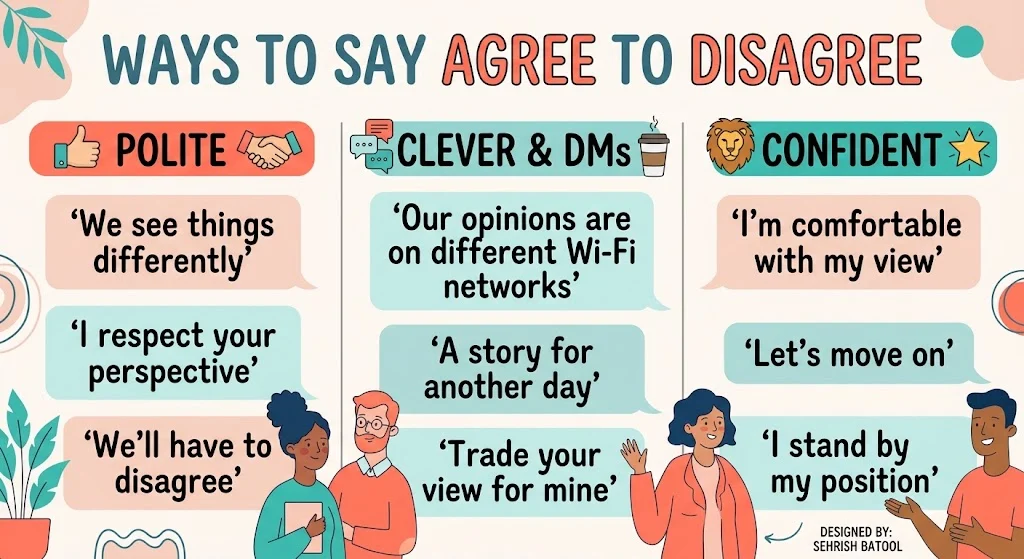
- We’ll have to agree to disagree on this one.Example: When a discussion has reached a natural stopping point.Meaning: It closes the debate without creating unnecessary tension.
- I understand where you’re coming from, but I see things differently.Example: When you understand someone’s reasoning but still hold your position.Meaning: It combines empathy with honest disagreement.
- I think we may need to leave it there.Example: When a conversation keeps repeating the same arguments.Meaning: It gently signals that continuing is unlikely to help.
- We can have different opinions and still respect each other.Example: When a disagreement starts affecting a friendship.Meaning: It prioritizes mutual respect over winning an argument.
- I appreciate your point of view, even if I don’t share it.Example: When someone has explained their position thoughtfully.Meaning: It recognizes their contribution without changing your stance.
- It seems we have different ways of looking at this.Example: When discussing a topic with a colleague or family member.Meaning: It frames the disagreement as a difference in perspective.
- I think we both have our reasons for seeing it this way.Example: When both people have personal experiences shaping their opinions.Meaning: It acknowledges that different viewpoints can have understandable foundations.
- Let’s respect each other’s opinions and move forward.Example: When a group needs to return to a shared task.Meaning: It encourages cooperation despite disagreement.
- I hear what you’re saying, even if I don’t fully agree.Example: When someone wants to feel heard during a difficult discussion.Meaning: It shows that listening doesn’t require agreement.
- We may not reach the same conclusion, and that’s okay.Example: When a conversation has become unproductive.Meaning: It accepts that consensus isn’t always necessary.
- I value our conversation, even though we disagree.Example: When you want to preserve a positive relationship after a debate.
2. Funny Ways to Say Agree to Disagree
A little humor can take the pressure out of a disagreement. Use these playful replies with people who understand your sense of humor and won’t mistake the joke for an insult.
- Let’s call it a draw before someone needs a referee.Example: When friendly banter starts getting competitive.Meaning: It turns the disagreement into a playful contest.
- Our opinions are clearly on different Wi-Fi networks.Example: When a friend has a completely different take on something.Meaning: It humorously suggests that your perspectives aren’t connecting.
- Let’s save our energy for something equally pointless.Example: When arguing over a trivial preference with a close friend.Meaning: It pokes fun at the debate and suggests moving on.
- The debate committee has officially adjourned.Example: When a group chat keeps revisiting the same argument.Meaning: It playfully announces the end of the discussion.
- You keep your opinion, and I’ll keep my excellent taste.Example: When joking about music, movies, or food preferences.Meaning: It defends your preference with exaggerated confidence.
- We’re going to need two separate documentaries for this one.Example: When both sides have completely different stories about an event.Meaning: It humorously highlights how differently you interpret the situation.
- Let’s agree to disagree and get back to being iconic.Example: When teasing a friend after a harmless argument.Meaning: It keeps the mood light and the friendship intact.
- This debate has more seasons than my favorite show.Example: When a familiar argument keeps coming back.Meaning: It jokes about how long the disagreement has lasted.
- Our opinions have officially unfollowed each other.Example: When joking about conflicting tastes in a group chat.Meaning: It uses social media language to describe a difference of opinion.
- Let’s put this argument on airplane mode.Example: When you want to stop a circular discussion.Meaning: It suggests disconnecting from the debate for a while.
- Different brains, different playlists.Example: When you and a friend disagree about entertainment or lifestyle choices.Meaning: It celebrates different preferences in a simple, playful way.
- The jury is divided, and everyone wants snacks.Example: When a group debate has gone on long enough.Meaning: It makes the disagreement sound like a funny courtroom scene.
3. Professional Ways to Say Agree to Disagree
Workplace disagreements call for calm, precise language. These alternatives help you close a discussion respectfully without damaging working relationships or making the conversation personal.
- I recognize your position, although my assessment differs.Example: When discussing competing recommendations during a meeting.Meaning: It communicates disagreement in a measured, professional tone.
- It appears we have reached different conclusions based on our assessments.Example: When colleagues interpret the same information differently.Meaning: It identifies the difference without assigning blame.
- I respect your analysis, even though I interpret the findings differently.Example: When reviewing research or project results with a colleague.Meaning: It separates respect for the person from disagreement about the conclusion.
- We may need to proceed with the understanding that our views differ.Example: When a team must move forward without full agreement.Meaning: It accepts disagreement while keeping the work moving.
- I believe we have explored both positions sufficiently for now.Example: When a meeting has covered the main arguments on each side.Meaning: It suggests ending the discussion without sounding dismissive.
- Let’s document both perspectives and determine the next steps.Example: When a project team needs a record of differing recommendations.Meaning: It turns disagreement into a practical action plan.
- I appreciate the discussion, although I remain unconvinced.Example: When someone has presented an argument that hasn’t changed your assessment.Meaning: It is courteous while remaining honest about your position.
- We can acknowledge the difference and focus on our shared objectives.Example: When coworkers disagree about methods but share the same goal.Meaning: It redirects attention toward productive collaboration.
- I suggest we move forward without requiring complete agreement.Example: When a team decision doesn’t depend on everyone sharing the same opinion.Meaning: It supports progress while acknowledging differing views.
- Our interpretations differ, and I think that’s clear at this stage.Example: When a professional discussion has become repetitive.Meaning: It calmly identifies the disagreement and signals closure.
- Let’s revisit this if new information becomes available.Example: When neither side has enough evidence to settle an issue.Meaning: It leaves room for reconsideration without prolonging the debate.
- I believe we can proceed respectfully despite this difference of opinion.Example: When maintaining a productive relationship with a colleague is important.Meaning: It reinforces professionalism and cooperation.
4. Funny and Sarcastic Ways to Say Agree to Disagree
For friends who appreciate dry humor, a slightly sarcastic line can make it easier to end a debate. Keep the delivery playful so the other person understands that you’re joking.
- Well, we can’t both be right. Apparently.Example: When joking with a friend who refuses to change their mind.Meaning: It expresses mock frustration without necessarily being hostile.
- I’ll let you enjoy your version of reality.Example: When teasing someone over a harmless disagreement.Meaning: It playfully suggests that you have very different interpretations.
- Let’s agree to disagree before this becomes a podcast series.Example: When a conversation has gone on far too long.Meaning: It exaggerates the debate’s length to encourage closure.
- My opinion and yours have chosen separate career paths.Example: When your views on a topic seem unlikely to meet.Meaning: It humorously describes two opinions going in different directions.
- We are clearly not reading from the same script.Example: When you and another person interpret an event differently.Meaning: It points out the difference in your perspectives.
- I see your point. I just don’t see the appeal.Example: When discussing a movie, trend, or personal preference.Meaning: It acknowledges their argument while keeping your disagreement clear.
- Let’s end this before we both start giving TED Talks.Example: When a casual disagreement turns into lengthy speeches.Meaning: It makes fun of the debate’s seriousness and encourages a pause.
- I respect your right to be confidently different.Example: When teasing someone about a strong opinion.Meaning: It recognizes their confidence while maintaining your own position.
- Our opinions are having a very peaceful breakup.Example: When ending a friendly disagreement with humor.Meaning: It makes separation between viewpoints sound lighthearted.
- Let’s put our differences in separate folders.Example: When a discussion needs to end so everyone can focus.Meaning: It suggests keeping the disagreement contained rather than escalating it.
- The fact-checkers may need a holiday after this.Example: When debating a complicated topic with a friend.Meaning: It jokes about how difficult the discussion has become.
- Let’s agree to disagree before the group chat files a complaint.Example: When friends are tired of seeing the same argument in their chat.Meaning: It uses humor to signal that the debate has run its course.
5. Short and Simple Ways to Say Agree to Disagree
Sometimes a quick sentence is all you need. These short alternatives work well in texts, everyday conversations, and situations where a long explanation would only prolong the disagreement.
- We see it differently.Example: When you want a neutral way to end a brief disagreement.Meaning: It acknowledges different perspectives without judgment.
- Fair enough, let’s move on.Example: When you accept that neither person is changing their mind.Meaning: It closes the topic and redirects attention elsewhere.
- Let’s leave it there.Example: When a discussion has reached a natural stopping point.Meaning: It asks to end the conversation without further debate.
- Different views, same respect.Example: When reminding a friend that disagreement doesn’t have to harm a relationship.Meaning: It puts mutual respect ahead of agreement.
- We don’t have to agree.Example: When someone assumes everyone must share their opinion.Meaning: It affirms that differences are acceptable.
- Let’s call it here.Example: When a debate is going nowhere.Meaning: It clearly signals that you’re ready to stop.
- I see it another way.Example: When you want to state your disagreement simply.Meaning: It expresses an alternative viewpoint without confrontation.
- Let’s move forward.Example: When a team or group needs to focus on what’s next.Meaning: It shifts attention from disagreement to action.
- We’ll leave it at that.Example: When you’ve explained your position and don’t want to repeat it.Meaning: It provides a straightforward ending to the discussion.
- No need to settle this today.Example: When a difficult topic needs more time or reflection.Meaning: It removes pressure to reach an immediate conclusion.
- Different opinions are okay.Example: When reassuring someone after a minor argument.Meaning: It normalizes disagreement without making it personal.
- Let’s agree to differ.Example: When you want a compact alternative to the familiar phrase.Meaning: It expresses acceptance that your opinions won’t align.
6. Respectful Ways to Disagree Without Being Rude
When emotions are running high, respectful language helps you express your position without making the other person feel attacked.
- I understand your reasoning, even though I reach a different conclusion.Example: When a friend explains a position you don’t share.Meaning: It shows that you considered their argument fairly.
- I don’t want this difference to affect how we treat each other.Example: When a disagreement involves someone important to you.Meaning: It protects the relationship from becoming a casualty of the debate.
- We can disagree without making this personal.Example: When a conversation starts involving personal criticism.Meaning: It asks both people to focus on the issue rather than each other.
- I respect you too much to turn this into an argument.Example: When a discussion with a close friend starts becoming heated.Meaning: It emphasizes that the relationship matters more than winning.
- Your experience may lead you to a different conclusion than mine.Example: When personal backgrounds influence different opinions.Meaning: It recognizes that people can interpret situations through different experiences.
- I appreciate you sharing your thoughts with me.Example: When someone has openly explained a different viewpoint.Meaning: It shows gratitude for the conversation without implying agreement.
- I don’t think either of us needs to prove anything here.Example: When a discussion turns into a competition.Meaning: It removes the pressure to win or establish superiority.
- Let’s make room for both perspectives.Example: When a group is discussing an issue with several reasonable viewpoints.Meaning: It encourages openness rather than forcing a single opinion.
- I would rather preserve our understanding than keep arguing.Example: When a disagreement threatens a valued relationship.Meaning: It prioritizes connection over continuing the debate.
- We can leave this conversation with mutual respect.Example: When ending a sensitive discussion on a positive note.Meaning: It offers a constructive way to close the conversation.
- I don’t share your view, but I respect your right to hold it.Example: When discussing personal beliefs or opinions.Meaning: It distinguishes disagreement from disrespect.
- Let’s focus on understanding each other, not changing each other.Example: When a conversation keeps circling back to persuasion.Meaning: It encourages listening instead of trying to control another person’s beliefs.
7. Confident Ways to Say Agree to Disagree
You don’t need to become defensive to stand by your beliefs. These responses communicate confidence without insulting the person who disagrees with you.
- I’ve considered your point, and my position remains the same.Example: When someone repeats an argument you’ve already considered.Meaning: It confirms that your opinion is deliberate rather than impulsive.
- I’m comfortable holding a different opinion.Example: When someone pressures you to agree with them.Meaning: It expresses self-assurance without aggression.
- I don’t need us to agree for me to respect you.Example: When a disagreement involves someone whose relationship matters to you.Meaning: It separates personal respect from shared beliefs.
- I’ve made my case, and I’m happy to leave it there.Example: When you’ve explained your reasoning and want to stop debating.Meaning: It shows confidence and a willingness to end the exchange.
- I stand by my view, and I respect yours.Example: When both people have clearly stated their positions.Meaning: It combines conviction with fairness.
- We can disagree without either of us backing down.Example: When a disagreement doesn’t require a winner.Meaning: It frames differing opinions as compatible with mutual respect.
- I’m open to discussion, not endless repetition.Example: When someone keeps making the same point.Meaning: It welcomes meaningful dialogue while setting a limit.
- My perspective doesn’t have to match yours to be valid to me.Example: When someone dismisses your opinion because they disagree.Meaning: It affirms your right to think independently.
- I’ve heard your argument, and I’ve made my decision.Example: When you have considered the information and reached a conclusion.Meaning: It communicates a clear and considered boundary.
- I’m not trying to win; I’m explaining how I see it.Example: When someone treats a discussion like a competition.Meaning: It clarifies that your goal is expression rather than domination.
- We can stand on different sides of this and still move forward.Example: When colleagues or friends need to continue working together.Meaning: It demonstrates confidence in cooperation despite disagreement.
- I’m at peace with us seeing this differently.Example: When you’re ready to stop defending your opinion.Meaning: It communicates calm acceptance rather than frustration.
8. Kind Ways to Say Agree to Disagree to Friends
Friendships don’t require matching opinions on every subject. These replies help you keep the connection strong while making space for different views.
- We don’t agree on everything, and that’s part of being friends.Example: When a friend worries that a disagreement might change your relationship.Meaning: It reassures them that different opinions are normal.
- You’re still my friend, even when your takes are questionable.Example: When joking with a close friend about a harmless difference.Meaning: It combines affection with friendly teasing.
- Let’s save our friendship and retire this debate.Example: When an argument is becoming more frustrating than useful.Meaning: It prioritizes the relationship over continuing the discussion.
- I love that we can be honest, even when we disagree.Example: When appreciating a friendship that allows open discussion.Meaning: It values honesty and emotional safety.
- Let’s disagree on this and agree on lunch.Example: When you want to move on from a small disagreement with a friend.Meaning: It redirects the conversation toward spending time together.
- Our opinions can differ without changing our bond.Example: When discussing a sensitive subject with someone close.Meaning: It reinforces the stability of your friendship.
- I’ll keep my opinion, but you’re still invited to hang out.Example: When a casual argument has made plans feel awkward.Meaning: It reassures your friend that the disagreement isn’t personal.
- We’re friends, not identical copies of each other.Example: When someone expects you to share all their preferences.Meaning: It celebrates individuality within a friendship.
- Let’s put the debate away and keep the good vibes.Example: When a group of friends wants to return to having fun.Meaning: It encourages a lighter mood and a fresh start.
- You do you, and I’ll do me, with love.Example: When accepting a friend’s different lifestyle choice.Meaning: It expresses affection while respecting independence.
- I value us more than being right about this.Example: When an argument is starting to damage a close relationship.Meaning: It places friendship above winning.
- Different opinions, same team.Example: When reminding a friend that you’re still on their side.Meaning: It emphasizes loyalty despite disagreement.
9. Mature Ways to Say Agree to Disagree
Maturity means recognizing when a conversation has reached its limit. These responses are useful when you want to remain composed and avoid unnecessary conflict.
- Not every disagreement needs a resolution.Example: When a topic has no clear answer or shared conclusion.Meaning: It accepts that some differences can remain unresolved.
- I think we have reached the limits of this discussion.Example: When both sides have explained their reasoning fully.Meaning: It signals that further debate may not be productive.
- We can accept the difference without settling it.Example: When neither person is willing to change their position.Meaning: It encourages acceptance rather than forced consensus.
- I can understand your position without adopting it.Example: When someone believes understanding requires agreement.Meaning: It distinguishes empathy from changing your beliefs.
- Let’s allow each other the space to think differently.Example: When a personal disagreement feels emotionally charged.Meaning: It encourages independence and emotional maturity.
- We may be approaching this from different experiences.Example: When background or circumstances influence your views.Meaning: It recognizes that experiences shape how people interpret issues.
- I don’t think another round of debate will help us.Example: When the same points keep being repeated.Meaning: It sets a reasonable limit without blaming either person.
- We can leave room for uncertainty.Example: When the available information doesn’t settle the issue.Meaning: It shows humility about what either person knows.
- I respect that we have arrived at different conclusions.Example: When ending a thoughtful discussion with a colleague or friend.Meaning: It recognizes the legitimacy of differing conclusions.
- Let’s accept what we can’t resolve right now.Example: When a discussion needs a pause or more information.Meaning: It encourages patience instead of forcing an immediate answer.
- I don’t need the last word to feel heard.Example: When a debate has become a contest over who speaks last.Meaning: It demonstrates emotional security and self-control.
- We can move on without pretending we agree.Example: When the relationship or task requires progress despite disagreement.Meaning: It supports honesty and forward movement at the same time.
10. Clever Ways to Say Agree to Disagree
A clever reply can make your point without repeating the same phrase. These alternatives are ideal when you want to sound thoughtful, articulate, and a little memorable.
- We’re looking at the same picture from different angles.Example: When two people interpret the same event differently.Meaning: It suggests that perspective shapes interpretation.
- Consensus isn’t the only sign of understanding.Example: When someone assumes that a good discussion must end in agreement.Meaning: It highlights the value of understanding without consensus.
- We can share the conversation without sharing the conclusion.Example: When discussing a complicated issue with a thoughtful person.Meaning: It shows that productive discussion doesn’t require identical views.
- Different conclusions don’t always mean faulty reasoning.Example: When both sides have reasonable arguments based on different assumptions.Meaning: It encourages fairness when evaluating disagreement.
- Our common ground may simply be mutual respect.Example: When searching for a point of agreement in a difficult discussion.Meaning: It identifies respect as a useful shared foundation.
- We don’t need a unanimous verdict on every question.Example: When a group is debating a matter of personal preference.Meaning: It reminds everyone that unanimity isn’t always necessary.
- The discussion can end even if the disagreement doesn’t.Example: When you need to finish a conversation without resolving it.Meaning: It separates ending a debate from settling the issue.
- Agreement and understanding are two different things.Example: When someone thinks you haven’t listened because you disagree.Meaning: It clarifies that understanding doesn’t require adopting another person’s view.
- We may share the facts and differ on their meaning.Example: When people interpret the same evidence differently.Meaning: It identifies interpretation as a possible source of disagreement.
- Let’s leave space for more than one reasonable perspective.Example: When discussing a complex issue with several possible explanations.Meaning: It encourages intellectual openness.
- A difference of opinion isn’t necessarily a failure of communication.Example: When a discussion has been respectful but hasn’t produced agreement.Meaning: It normalizes disagreement even when people understand each other.
- We can close the debate without closing our minds.Example: When you want to stop talking but remain open to future evidence.Meaning: It balances a clear boundary with intellectual flexibility.
11. Gentle Ways to End an Argument
When the mood is tense, a gentle closing line can help everyone step back without feeling ignored or dismissed.
- Maybe we should take a break from this topic.Example: When emotions are rising during a personal discussion.Meaning: It suggests a pause before the disagreement escalates.
- I think we’ve both said what we needed to say.Example: When each person has had a chance to explain their position.Meaning: It acknowledges both contributions and signals closure.
- Let’s come back to this when we’re feeling calmer.Example: When frustration is preventing a productive conversation.Meaning: It leaves the door open for a better discussion later.
- I don’t want this conversation to become hurtful.Example: When a disagreement starts involving harsh remarks.Meaning: It explains your reason for slowing the conversation down.
- We can pause without solving everything right now.Example: When a complicated issue feels too difficult to settle immediately.Meaning: It removes the pressure to find an instant solution.
- I think a little space would help us both.Example: When you need time to process a disagreement.Meaning: It requests distance without rejecting the relationship.
- Let’s give each other time to think about this.Example: When new information or emotions need time to settle.Meaning: It encourages reflection before continuing.
- I’d rather continue this conversation when we can listen properly.Example: When both people are interrupting or talking over each other.Meaning: It prioritizes attentive listening over immediate resolution.
- We don’t have to finish this discussion today.Example: When a disagreement is taking too much emotional energy.Meaning: It allows the topic to remain open without continuing now.
- Let’s take a breath and leave this here for now.Example: When a discussion is becoming overwhelming.Meaning: It encourages a calm pause before the situation worsens.
- I care about what you’re saying, but I need a moment.Example: When you want to listen but feel emotionally overloaded.Meaning: It communicates care while expressing a need for space.
- We can revisit this when we’re ready.Example: When you want to pause a difficult conversation without permanently avoiding it.Meaning: It offers a gentle way to end the current exchange.
12. Ways to Say Agree to Disagree Over Text
Text messages can make disagreements feel sharper because the other person can’t hear your tone. These replies are clear, calm, and easy to send in a chat.
- I get your point, but I see it differently.Example: When replying to a friend’s opinion in a text thread.Meaning: It acknowledges their view while keeping yours clear.
- Let’s leave this one here 😊Example: When a casual debate is becoming repetitive in messages.Meaning: It softens the decision to end the discussion.
- Fair enough, we’re not going to agree on this one.Example: When you’ve both explained your positions over text.Meaning: It accepts the disagreement without adding tension.
- Different opinions, no hard feelings.Example: When you want to reassure someone after a disagreement.Meaning: It separates the debate from personal feelings.
- I hear you. I’m just not seeing it the same way.Example: When someone thinks you’re ignoring their point in a chat.Meaning: It shows you’ve listened without pretending to agree.
- Let’s save our thumbs and call it a day.Example: When a long text argument is going nowhere.Meaning: It uses humor to encourage both people to stop typing.
- We’re going in circles now, so let’s pause.Example: When the same arguments keep appearing in your messages.Meaning: It identifies the repetition and suggests stopping.
- I respect your take, even if it’s not mine.Example: When discussing opinions or preferences with a friend online.Meaning: It expresses respect in a casual, modern tone.
- We can disagree and still be good.Example: When you want to keep a friendship comfortable after a tense chat.Meaning: It reassures the other person that the relationship remains intact.
- Let’s not turn a difference of opinion into a whole thing.Example: When a small disagreement is becoming unnecessarily intense.Meaning: It encourages proportion and perspective.
- I’ll let you have your take, and I’ll keep mine.Example: When a conversation has reached an impasse.Meaning: It accepts separate opinions without requiring a winner.
- No agreement today, but we’re good.Example: When ending a disagreement with someone you care about.Meaning: It closes the conversation while maintaining warmth.
13. Ways to Say Agree to Disagree Without Saying It Directly
You don’t always have to mention disagreement explicitly. Sometimes a natural change of direction or a calm statement is enough to end the debate.
- I think we’ve covered this pretty thoroughly.Example: When both sides have repeated their arguments several times.Meaning: It implies that the discussion has reached its limit.
- Let’s focus on what we can move forward with.Example: When a team needs to make progress despite differing opinions.Meaning: It redirects attention toward practical next steps.
- That’s an interesting way to look at it.Example: When acknowledging a viewpoint without wanting to debate it further.Meaning: It recognizes the other person’s perspective without endorsing it.
- I’ll keep that in mind.Example: When someone offers an opinion you aren’t ready to accept.Meaning: It acknowledges their input without promising agreement.
- I think we’ve reached a natural stopping point.Example: When a discussion has run its course.Meaning: It signals closure in a calm and neutral way.
- Let’s turn our attention to the next thing.Example: When a group needs to return to its agenda.Meaning: It moves the conversation away from the unresolved issue.
- I appreciate hearing another perspective.Example: When you want to acknowledge a different view and move on.Meaning: It expresses openness without implying that your mind has changed.
- We may need to approach this from separate angles.Example: When working with someone who prefers a different method.Meaning: It allows for different approaches without forcing a single solution.
- Let’s see how things develop from here.Example: When time or new information may clarify a disagreement.Meaning: It postpones a final conclusion without dismissing the issue.
- I’ll think about what you’ve said.Example: When you want time to reflect before responding further.Meaning: It shows that you’re willing to consider their point.
- For now, let’s focus on the bigger picture.Example: When a minor disagreement is distracting from a shared goal.Meaning: It redirects attention toward the larger purpose.
- I think we can leave the conclusion open.Example: When neither side has enough reason to settle the question.Meaning: It allows uncertainty without extending the debate.
14. Strong but Respectful Ways to Set Boundaries
Sometimes the issue isn’t just disagreement. The conversation may be exhausting, intrusive, or disrespectful. These replies help you end it firmly without resorting to personal attacks.
- I’ve shared my perspective, and I don’t want to keep defending it.Example: When someone repeatedly demands that you justify a personal preference.Meaning: It sets a clear limit on repeated questioning.
- I’m happy to discuss this respectfully, but not argue in circles.Example: When a conversation keeps repeating the same points.Meaning: It establishes that respectful discussion is welcome but endless conflict is not.
- You don’t have to agree with me, and I don’t have to agree with you.Example: When someone insists that their opinion must be accepted.Meaning: It affirms both people’s right to hold different views.
- I’m ending this conversation before it becomes disrespectful.Example: When personal insults begin entering a disagreement.Meaning: It clearly communicates that you won’t continue under those conditions.
- My answer hasn’t changed, so I’d like to move on.Example: When someone keeps asking the same question in hopes of a different response.Meaning: It reinforces your position and ends repetition.
- I’m not comfortable continuing this discussion.Example: When a topic becomes too personal or upsetting.Meaning: It states a boundary without attacking the other person.
- We can talk when we’re both ready to listen respectfully.Example: When someone interrupts or dismisses you repeatedly.Meaning: It makes respectful listening a condition for continuing.
- I won’t pretend to agree just to end an argument.Example: When someone pressures you to say you agree.Meaning: It protects your honesty and independence.
- I understand your position, and I’m asking you to respect mine.Example: When someone continues challenging a clearly stated boundary.Meaning: It requests mutual respect without escalating the disagreement.
- This topic isn’t productive for us right now.Example: When a conversation is creating frustration without progress.Meaning: It identifies the problem as the discussion’s direction rather than either person’s worth.
- I’m choosing to step away instead of continuing this argument.Example: When you need to disengage from a heated exchange.Meaning: It presents leaving as a deliberate choice to avoid escalation.
- We don’t need to resolve this for me to end the conversation.Example: When another person refuses to stop arguing until they get agreement.Meaning: It makes clear that ending a conversation doesn’t require consensus.
15. Warm and Positive Ways to Agree to Disagree
When you want the conversation to end on a good note, positive wording can preserve goodwill and leave room for future discussions.
- I’m glad we can talk openly, even when we see things differently.Example: When ending a thoughtful conversation with a friend or partner.Meaning: It values honest communication and mutual respect.
- We may disagree here, but I appreciate your honesty.Example: When someone has shared a sincere opinion that differs from yours.Meaning: It shows appreciation for openness without giving up your position.
- Different perspectives make conversations interesting.Example: When discussing a topic with someone who enjoys exchanging ideas.Meaning: It presents disagreement as an opportunity to learn.
- Let’s keep the respect and leave the debate behind.Example: When a discussion has become more intense than necessary.Meaning: It prioritizes the relationship over the argument.
- I’m happy we can be honest with each other.Example: When a disagreement has been handled calmly.Meaning: It reinforces trust and open communication.
- We don’t see eye to eye, but we can still understand each other.Example: When you want to close a conversation without dismissing the other person’s view.Meaning: It emphasizes understanding despite disagreement.
- Here’s to different opinions and good conversations.Example: When ending a friendly debate at a social gathering.Meaning: It celebrates the exchange without needing a winner.
- I respect your honesty, and I hope you respect mine.Example: When both people have openly shared their views.Meaning: It invites equal respect for both perspectives.
- We can leave this topic with goodwill.Example: When ending a sensitive conversation on a peaceful note.Meaning: It encourages a positive ending despite unresolved differences.
- I’m glad we can disagree without losing sight of what matters.Example: When a friendship or partnership has survived a challenging discussion.Meaning: It recognizes the importance of the relationship beyond the disagreement.
- Let’s keep learning from each other, even when we don’t agree.Example: When discussing a topic with someone whose views differ from yours.Meaning: It keeps communication open and encourages mutual growth.
- Different opinions, mutual respect, and no need for a winner.Example: When you want to end a debate with a clear, positive message.Meaning: It reinforces that respectful disagreement doesn’t need to become a competition.
FAQs
What Does “Agree to Disagree” Mean?
It means accepting that two people have different opinions without requiring either person to change their mind.
What Is Another Way to Say “Agree to Disagree”?
Try “We see things differently,” “Let’s leave it there,” or “I respect your perspective.”
Is “Agree to Disagree” Rude?
Not necessarily. It usually sounds respectful, but a dismissive tone can make it feel rude.
How Do You Say Agree to Disagree Professionally?
Say, “I respect your assessment, although my conclusion differs,” to remain courteous and clear.
How Do You Say Agree to Disagree Without Hurting Feelings?
Acknowledge the other person’s view, explain your difference calmly, and emphasize mutual respect.
Is Agreeing to Disagree a Good Thing in Relationships?
Yes. Healthy relationships allow differences of opinion without turning every disagreement into a conflict.
How Do You Say Agree to Disagree Over Text?
Try “Different opinions, no hard feelings” or “I hear you, but I see it differently.”
Can Agreeing to Disagree Sound Sarcastic?
Yes. Your wording and tone matter, especially with lines that tease or dismiss the other person’s opinion.
What If Someone Won’t Agree to Disagree?
Calmly repeat your boundary and end the discussion if it becomes repetitive or disrespectful.
Does Agreeing to Disagree Mean Giving Up?
No. It means choosing not to continue a debate that may not lead to understanding or agreement.
Conclusion
Knowing different ways to say agree to disagree can make everyday conversations easier, from friendly debates and family discussions to workplace meetings and complicated text exchanges. You can be funny without being hurtful, confident without being arrogant, and respectful without pretending to share someone else’s opinion. The goal isn’t to win every conversation; it’s to communicate clearly while protecting your peace and your relationships. Choose a response that fits the moment, and don’t be afraid to set a boundary when a discussion stops being productive. Save this list for your next debate, share it with someone who loves a good argument, and remember: different opinions don’t have to mean bad vibes!