The best replies to “let’s just be friends” depend on your feelings and the situation. You can respond with humor, grace, confidence, or honesty without making things awkward.
Few texts can change your mood faster than “Let’s just be friends.” One minute, you’re smiling at your phone, imagining a romantic future, and the next, you’re wondering whether to reply with a heart emoji or throw your phone onto the bed.
The good news? You don’t have to make things awkward, pretend you’re completely fine, or deliver a dramatic speech worthy of a season finale. The best replies to let’s just be friends reflect how you genuinely feel while respecting the other person’s decision.
1. Funny Responses to “Let’s Just Be Friends”
Sometimes humor makes an uncomfortable moment easier to handle. These replies keep things light without insulting the other person.
1. “Friendship application accepted.”
Example: When you want to respond playfully after a crush draws the line.
Meaning: You accept the decision with a little humor.
2. “Well, there goes my romantic comedy plot.”
Example: When you both usually joke around about relationships.
Meaning: You acknowledge the unexpected turn without taking it too seriously.
3. “Can I at least get a friendship starter pack?”
Example: When you want to make the moment less awkward.
Meaning: You turn the situation into a lighthearted joke.
4. “Guess we’re entering the friendship era.”
Example: When you want a playful response for a text or DM.
Meaning: You show that you’re willing to move forward.
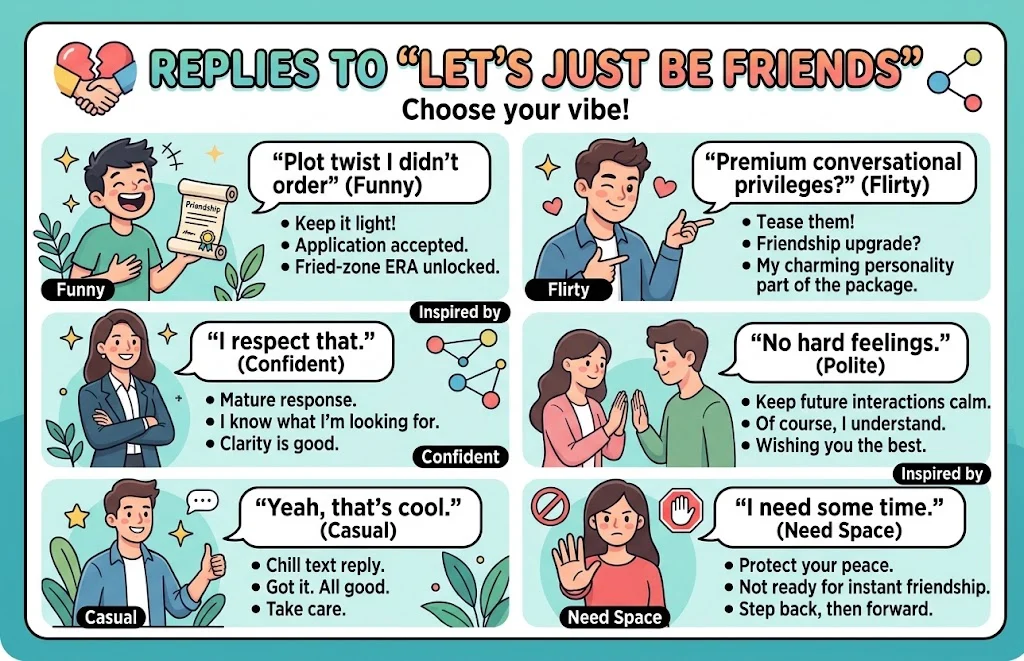
5. “Plot twist I definitely didn’t order.”
Example: When you genuinely didn’t expect the rejection.
Meaning: You express surprise without sounding bitter.
6. “Okay, but I’m still claiming the aux cord.”
Example: When you already share music or hang out together.
Meaning: You keep the mood friendly and familiar.
7. “Friendship unlocked. Achievement completed.”
Example: When you want a gaming-inspired comeback.
Meaning: You treat the situation as a humorous new chapter.
8. “At least I passed the human-being test.”
Example: When you want to laugh off an awkward moment.
Meaning: You find a little humor in the outcome.
9. “Fine, but I’m not sharing my fries.”
Example: When you want to keep your reply casual and funny.
Meaning: You suggest that friendship comes with playful boundaries.
10. “My imaginary wedding planner is devastated.”
Example: When your relationship conversations have been playful.
Meaning: You exaggerate your disappointment for comedic effect.
11. “Friend zone membership confirmed.”
Example: When you both understand the familiar friend-zone joke.
Meaning: You acknowledge the change with self-aware humor.
12. “Well, at least the group chat survives.”
Example: When you belong to the same social circle.
Meaning: You focus on preserving a comfortable friendship.
2. Confident Responses to “Let’s Just Be Friends”
Confidence means accepting someone’s decision without begging for attention or pretending your feelings never existed.
1. “I respect that. No hard feelings.”
Example: When you want to respond maturely to a clear rejection.
Meaning: You accept their choice with self-respect.
2. “Thanks for being honest with me.”
Example: When the other person communicates their feelings directly.
Meaning: You appreciate clarity rather than mixed signals.
3. “That’s fair. I know what I’m looking for, too.”
Example: When you want to acknowledge that your relationship goals differ.
Meaning: You recognize that compatibility matters to both people.
4. “I appreciate the clarity. Let’s leave it there.”
Example: When you want to end the romantic conversation gracefully.
Meaning: You accept the answer without inviting unnecessary debate.
5. “No worries. I won’t force a connection.”
Example: When you want to establish a healthy boundary.
Meaning: You understand that attraction cannot be demanded.
6. “I respect your feelings, and I respect mine.”
Example: When you need to acknowledge your own emotional needs.
Meaning: You value both people’s boundaries equally.
7. “That’s okay. I’d rather have honesty than uncertainty.”
Example: When you’ve been unsure about where the relationship stands.
Meaning: You prefer a clear answer over prolonged confusion.
8. “I understand. I’ll focus on what feels right for me.”
Example: When you need some space to move forward.
Meaning: You prioritize your own well-being.
9. “Thanks for telling me directly.”
Example: When you appreciate a straightforward conversation.
Meaning: You acknowledge their honesty without making things complicated.
10. “We’re looking for different things, and that’s okay.”
Example: When you want to close the conversation on mature terms.
Meaning: You accept that different expectations can make a relationship unsuitable.
11. “I can accept that without changing who I am.”
Example: When rejection makes you question your self-worth.
Meaning: You remind yourself that another person’s feelings do not define your value.
12. “I wish you well, whatever happens next.”
Example: When you want a peaceful and respectful ending.
Meaning: You let the situation go without resentment.
3. Polite Responses to “Let’s Just Be Friends”
Polite replies are ideal when you care about the person and want to avoid unnecessary tension.
1. “Of course, I understand.”
Example: When you want to keep your response brief and respectful.
Meaning: You acknowledge their decision without arguing.
2. “Thank you for being honest with me.”
Example: When someone explains that they don’t feel a romantic connection.
Meaning: You appreciate their openness.
3. “I respect your decision.”
Example: When you want to respond clearly without adding emotional pressure.
Meaning: You recognize their right to choose the relationship they want.
4. “That’s completely okay. I appreciate you telling me.”
Example: When you want to keep the conversation comfortable.
Meaning: You respond with understanding and courtesy.
5. “I hope we can keep things respectful.”
Example: When you expect to see the person regularly.
Meaning: You want to maintain a positive atmosphere.
6. “I understand where you’re coming from.”
Example: When you have listened to their explanation.
Meaning: You acknowledge their perspective.
7. “No problem. I wish you the best.”
Example: When you want to end the exchange on a positive note.
Meaning: You accept the outcome and move forward peacefully.
8. “I appreciate you being clear about your feelings.”
Example: When you want to recognize their direct communication.
Meaning: You value honesty even when the answer disappoints you.
9. “That’s fair. Thank you for letting me know.”
Example: When you need a simple response to an unexpected message.
Meaning: You accept the decision with courtesy.
10. “I hope things stay comfortable between us.”
Example: When you share friends or social activities.
Meaning: You want to avoid unnecessary awkwardness.
11. “I understand, and I won’t pressure you.”
Example: When you want to reassure someone that their decision is respected.
Meaning: You acknowledge their boundaries.
12. “Thanks for being considerate about this.”
Example: When someone has handled a difficult conversation gently.
Meaning: You appreciate the care they showed while communicating.
4. Flirty Responses to “Let’s Just Be Friends”
A little flirtation can work if the conversation is playful, but it should never become pressure. These replies keep your charm while respecting the other person’s answer.
1. “Friends? I suppose I can work with that.”
Example: When you want to sound playful without challenging their decision.
Meaning: You accept the suggestion with a hint of charm.
2. “Well, at least you have excellent taste in friends.”
Example: When you want a confident, flirtatious joke.
Meaning: You tease them while maintaining your self-esteem.
3. “Friendship is a pretty good place to start.”
Example: When you genuinely feel comfortable building a friendship.
Meaning: You leave room for a connection without expecting romance.
4. “Guess I’ll have to impress you with my friendship skills.”
Example: When the conversation already has a teasing tone.
Meaning: You turn the moment into a playful challenge.
5. “Deal, but my jokes are part of the package.”
Example: When humor is a big part of your connection.
Meaning: You show your personality while accepting their choice.
6. “At least we can still have legendary conversations.”
Example: When you enjoy talking to the person regularly.
Meaning: You highlight the value of your existing connection.
7. “Okay, but I’m keeping my charming personality.”
Example: When you want to stay lighthearted and confident.
Meaning: You retain your playful attitude without pursuing them.
8. “Friends with premium conversation privileges?”
Example: When you both enjoy witty texting.
Meaning: You make friendship sound like a fun arrangement.
9. “Fair enough. Friendship looks good on us, too.”
Example: When you genuinely like the person’s company.
Meaning: You embrace a different kind of connection.
10. “I’ll take the friendship upgrade.”
Example: When you want a short, modern reply.
Meaning: You frame the decision as a positive change.
11. “At least you won’t escape my excellent recommendations.”
Example: When you often exchange songs, shows, or books.
Meaning: You keep the interaction warm and teasing.
12. “Friendship it is. Your loss on the date-night playlist, though.”
Example: When you share a playful sense of humor.
Meaning: You joke about the missed romantic opportunity without demanding another chance.
5. Sarcastic Responses to “Let’s Just Be Friends”
Sarcasm can help you hide your embarrassment, but keep it gentle if you want to preserve the relationship.
1. “Ah, the classic plot development.”
Example: When the situation feels predictable in hindsight.
Meaning: You acknowledge the familiar rejection scenario with dry humor.
2. “Well, that escalated into friendship quickly.”
Example: When the conversation took an unexpected turn.
Meaning: You use irony to express surprise.
3. “And here I thought I was in a romantic subplot.”
Example: When you’ve been imagining a potential relationship.
Meaning: You joke about the difference between your expectations and reality.
4. “Excellent. My calendar was missing a friendship meeting.”
Example: When you want a dry, playful comeback.
Meaning: You respond to the awkwardness with exaggerated formality.
5. “Friendship. Such a plot twist.”
Example: When you want a short reply with a sarcastic edge.
Meaning: You highlight the unexpected change.
6. “Well, at least the mystery is solved.”
Example: When you’ve been unsure about their feelings.
Meaning: You express relief at finally receiving a clear answer.
7. “My expectations would like a quick meeting.”
Example: When you want to joke about being caught off guard.
Meaning: You acknowledge your disappointment through humor.
8. “A friendship proposal. How unexpectedly professional.”
Example: When you enjoy witty, formal-sounding jokes.
Meaning: You turn a personal moment into playful business language.
9. “Guess the romantic department is closed.”
Example: When you want to keep your reply amusing and brief.
Meaning: You acknowledge that romance is not an option.
10. “Well, that’s one way to change the storyline.”
Example: When you didn’t see the decision coming.
Meaning: You describe the change with understated irony.
11. “Not the ending I predicted, but noted.”
Example: When you want a composed response with a little attitude.
Meaning: You accept the information without pretending you expected it.
12. “Friendship it is. Very exclusive club, apparently.”
Example: When both of you appreciate dry humor.
Meaning: You playfully exaggerate the change in your relationship.
6. Cute Responses to “Let’s Just Be Friends”
Cute replies are perfect when you want to show kindness and keep the moment gentle.
1. “Okay, friendship hugs it is.”
Example: When you already share a warm, affectionate friendship.
Meaning: You embrace a friendly connection.
2. “That’s okay. I’m glad we met.”
Example: When you appreciate the experience regardless of the outcome.
Meaning: You express gratitude without resentment.
3. “Friends can make lovely memories, too.”
Example: When you genuinely want to preserve a friendship.
Meaning: You recognize that meaningful connections come in different forms.
4. “Deal. I’ll bring the good vibes.”
Example: When you want to make the transition feel positive.
Meaning: You offer a cheerful approach to friendship.
5. “I’m happy we can be honest with each other.”
Example: When open communication matters to you.
Meaning: You appreciate the trust behind the conversation.
6. “Okay, but our friendship better include memes.”
Example: When you usually exchange funny posts or videos.
Meaning: You keep the mood affectionate and playful.
7. “That’s sweet of you to tell me honestly.”
Example: When the person has handled your feelings carefully.
Meaning: You appreciate their consideration.
8. “I’m rooting for both of us.”
Example: When you want to wish each other well.
Meaning: You express hope for a healthy connection, whatever form it takes.
9. “Friendship sounds lovely, if it feels right for both of us.”
Example: When you want to leave room for your own feelings, too.
Meaning: You welcome friendship without ignoring your emotional needs.
10. “Here’s to good conversations and better memories.”
Example: When you want to start this new chapter positively.
Meaning: You focus on the potential for meaningful experiences.
11. “I’m glad we can still be kind to each other.”
Example: When you want to avoid tension after a difficult conversation.
Meaning: You value kindness and mutual respect.
12. “Sending friendly vibes your way.”
Example: When you want a short, warm message.
Meaning: You keep the exchange friendly without implying romance.
7. Chill and Casual Responses to “Let’s Just Be Friends”
Not every rejection needs a long discussion. Sometimes, a relaxed reply is all you need.
1. “Yeah, that’s cool.”
Example: When you want to acknowledge the message casually.
Meaning: You accept their decision without making it a big event.
2. “All good!”
Example: When you want a short, friendly response.
Meaning: You keep the interaction relaxed.
3. “No worries, we’re good.”
Example: When you want to reassure the other person.
Meaning: You signal that there is no need for an argument.
4. “Sounds fair to me.”
Example: When you agree that friendship is the right option.
Meaning: You accept the arrangement calmly.
5. “Sure, I can respect that.”
Example: When you want to sound easygoing but sincere.
Meaning: You recognize their preference.
6. “That’s fine by me.”
Example: When you’re genuinely comfortable with friendship.
Meaning: You show acceptance without unnecessary explanation.
7. “Got you. Thanks for being real.”
Example: When you appreciate a straightforward message.
Meaning: You acknowledge their honesty in a casual way.
8. “Okay, we’re on the same page now.”
Example: When the conversation has clarified your relationship.
Meaning: You appreciate knowing where things stand.
9. “Fair enough, no awkwardness needed.”
Example: When you want to keep future interactions comfortable.
Meaning: You prefer to move forward without unnecessary tension.
10. “Cool, let’s keep things simple.”
Example: When you want to avoid a long emotional exchange.
Meaning: You prefer a clear and uncomplicated relationship.
11. “I hear you.”
Example: When you want a brief response that still acknowledges their feelings.
Meaning: You show that you’ve understood the message.
12. “Okay, take care!”
Example: When you want to finish the conversation politely.
Meaning: You end the exchange on a calm note.
8. Emotional and Honest Responses to “Let’s Just Be Friends”
If the rejection hurts, you don’t have to pretend otherwise. Honest responses let you communicate your feelings without guilt-tripping anyone.
1. “I won’t lie, I was hoping for something more.”
Example: When you want to express your disappointment honestly.
Meaning: You share your feelings without blaming the other person.
2. “Thank you for being honest, even though it hurts a little.”
Example: When you appreciate the truth but need to acknowledge the pain.
Meaning: You recognize both your disappointment and their honesty.
3. “I respect your decision, but I may need some time.”
Example: When staying close immediately would feel difficult.
Meaning: You communicate a healthy emotional boundary.
4. “I genuinely liked you, so this isn’t easy for me.”
Example: When your feelings were stronger than the other person realized.
Meaning: You explain why the decision affects you.
5. “I understand, and I appreciate you telling me directly.”
Example: When you want to respond with honesty and maturity.
Meaning: You acknowledge the decision without hiding your disappointment.
6. “I need a little space to process everything.”
Example: When you feel overwhelmed after reading the message.
Meaning: You give yourself room to understand your emotions.
7. “I hoped we’d want the same thing.”
Example: When you thought the connection was becoming romantic.
Meaning: You express sadness about having different expectations.
8. “I’m disappointed, but I respect how you feel.”
Example: When you want to balance honesty with respect.
Meaning: You accept their decision while acknowledging your own feelings.
9. “I care about you, so I want to handle this thoughtfully.”
Example: When the relationship matters enough that you don’t want to react impulsively.
Meaning: You want to protect both people’s emotional well-being.
10. “I appreciate what we’ve shared, even if it wasn’t what I hoped for.”
Example: When you want to acknowledge the good parts of your connection.
Meaning: You value the experience without insisting it become romantic.
11. “I need to be honest with myself about whether friendship is right for me.”
Example: When you aren’t sure you can move past your feelings.
Meaning: You give yourself permission to choose an appropriate boundary.
12. “I wish things were different, but I won’t pressure you.”
Example: When you still have feelings but want to respect their choice.
Meaning: You express sadness without attempting to change their mind.
9. Sweet Responses That Preserve the Connection
Choose these messages when you genuinely value the person and want to leave the conversation with warmth.
1. “I’m glad you came into my life, regardless.”
Example: When the connection has already meant something to you.
Meaning: You express appreciation without attaching conditions.
2. “I respect your feelings and wish you happiness.”
Example: When you want to end the romantic discussion kindly.
Meaning: You prioritize mutual respect over disappointment.
3. “I’m grateful we got to know each other.”
Example: When you’ve shared meaningful conversations or experiences.
Meaning: You recognize the value of the connection.
4. “I hope we both find what we’re looking for.”
Example: When your romantic expectations don’t align.
Meaning: You wish both people well.
5. “Thank you for treating my feelings with care.”
Example: When someone communicates rejection thoughtfully.
Meaning: You acknowledge the kindness behind their honesty.
6. “You still matter to me as a person.”
Example: When you want to separate affection from romantic expectations.
Meaning: You recognize their value beyond dating.
7. “I hope we can keep the good memories.”
Example: When you’ve shared experiences you genuinely appreciate.
Meaning: You want to remember the positive parts of the connection.
8. “I appreciate the honesty more than you know.”
Example: When a clear answer helps you move forward.
Meaning: You value transparency.
9. “I hope life brings good things your way.”
Example: When you’re ready to close the conversation warmly.
Meaning: You offer a sincere and peaceful wish.
10. “I’m happy we crossed paths.”
Example: When you want a short message with genuine warmth.
Meaning: You appreciate having met the person.
11. “Let’s be kind to each other as we move forward.”
Example: When you expect to remain in each other’s lives.
Meaning: You encourage a respectful relationship.
12. “I wish you the kind of happiness you deserve.”
Example: When you want to communicate goodwill sincerely.
Meaning: You let the other person go without resentment.
10. Brutally Honest but Respectful Responses
Sometimes you need a firm answer rather than a cheerful one. These responses are direct without being insulting or manipulative.
1. “I was looking for a relationship, not just friendship.”
Example: When your romantic intentions were clear from the beginning.
Meaning: You state your expectations honestly.
2. “I respect your choice, but friendship isn’t what I wanted.”
Example: When you know a friendship would not meet your needs.
Meaning: You establish a clear boundary.
3. “I’d rather be honest than pretend I’m fine with something I’m not.”
Example: When you feel pressured to accept friendship immediately.
Meaning: You prioritize emotional honesty.
4. “I don’t think staying friends would be healthy for me right now.”
Example: When you need distance to move forward.
Meaning: You choose a boundary that supports your well-being.
5. “I appreciate the clarity. I’ll take it from here.”
Example: When you want to end the discussion firmly.
Meaning: You accept the answer and take responsibility for your next steps.
6. “I’m not upset with you, but I need to move on.”
Example: When you want to avoid blame while protecting your feelings.
Meaning: You communicate the need to create distance.
7. “I won’t try to convince someone to want me.”
Example: When you want to reinforce your own self-respect.
Meaning: You refuse to pressure someone into a relationship.
8. “We want different things, so it’s best to be clear.”
Example: When the difference in expectations is undeniable.
Meaning: You acknowledge the mismatch directly.
9. “I respect your answer, and I hope you’ll respect my need for space.”
Example: When you need time away after the rejection.
Meaning: You ask for your own boundaries to be honored.
10. “I don’t want to build a friendship on hidden expectations.”
Example: When you suspect you’d secretly hope for romance.
Meaning: You want a friendship that is emotionally honest.
11. “I know what I want, and I need to honor that.”
Example: When you are deciding not to accept a relationship that doesn’t suit you.
Meaning: You remain committed to your own needs.
12. “Thank you for being clear. I won’t misread the situation.”
Example: When you want to avoid future mixed signals.
Meaning: You acknowledge the boundary and intend to respect it.
11. Creative Responses to “Let’s Just Be Friends”
If you prefer something original over the usual “okay,” these creative lines can make your message memorable.
1. “New chapter, different title.”
Example: When you want a short, thoughtful reply.
Meaning: You accept that the relationship may take a different direction.
2. “Let’s give this storyline an honest ending.”
Example: When you want to acknowledge the romantic possibility without forcing it.
Meaning: You favor clarity over uncertainty.
3. “Friendship is a different kind of adventure.”
Example: When you genuinely welcome the possibility of friendship.
Meaning: You see value in another form of connection.
4. “Not the destination I imagined, but I understand.”
Example: When the outcome differs from your expectations.
Meaning: You acknowledge disappointment while accepting reality.
5. “Consider the romantic chapter respectfully closed.”
Example: When you enjoy clever, book-inspired language.
Meaning: You signal that you understand the relationship boundary.
6. “A different connection can still be meaningful.”
Example: When you want to focus on the positive side of the decision.
Meaning: You recognize that not every important relationship is romantic.
7. “I’ll let reality edit my expectations.”
Example: When you want a thoughtful response with a creative twist.
Meaning: You are adjusting your hopes to match the situation.
8. “No sequel to the romance, understood.”
Example: When you want a witty, movie-inspired reply.
Meaning: You accept that romance is not continuing.
9. “Different pages, perhaps the same book.”
Example: When you want to preserve a connection while accepting a change.
Meaning: You suggest that your relationship can evolve.
10. “Let’s keep the good parts and respect the rest.”
Example: When you want to preserve positive memories without denying reality.
Meaning: You balance appreciation with healthy boundaries.
11. “Friendship: a new possibility, not a consolation prize.”
Example: When you genuinely value friendship rather than viewing it as a lesser outcome.
Meaning: You treat friendship as worthwhile in its own right.
12. “I’ll follow the truth, not just the fantasy.”
Example: When you need to let go of an imagined romantic future.
Meaning: You choose to accept the situation as it is.
12. Professional Responses to “Let’s Just Be Friends”
If a coworker, classmate, colleague, or professional contact uses this phrase, keep your response courteous and appropriate.
1. “I understand, and I appreciate your honesty.”
Example: When a colleague clearly communicates their preference.
Meaning: You respond with professionalism and respect.
2. “Of course. I’ll respect that boundary.”
Example: When you want to ensure future workplace interactions remain appropriate.
Meaning: You acknowledge their preference.
3. “Thank you for clarifying your position.”
Example: When you want a composed response in a formal setting.
Meaning: You appreciate the clarity.
4. “That’s perfectly fine. Let’s keep things professional.”
Example: When you share a workplace or professional environment.
Meaning: You establish an appropriate working relationship.
5. “I appreciate your directness, and I respect your decision.”
Example: When the conversation requires maturity and discretion.
Meaning: You respond thoughtfully without escalating the situation.
6. “Understood. I’ll make sure our interactions remain comfortable.”
Example: When you expect to continue working together.
Meaning: You aim to preserve a respectful environment.
7. “Thank you for being clear about your expectations.”
Example: When you need to acknowledge a relationship boundary formally.
Meaning: You recognize the importance of clear communication.
8. “I respect that, and I hope we can work together comfortably.”
Example: When you share projects or professional responsibilities.
Meaning: You focus on maintaining a constructive relationship.
9. “That’s understandable. I value mutual respect.”
Example: When you want to emphasize courtesy.
Meaning: You prioritize respectful treatment.
10. “I appreciate the clarification. No further discussion is necessary.”
Example: When you want to close the topic professionally.
Meaning: You acknowledge the answer and move on.
11. “I understand. I’ll keep our communication appropriate.”
Example: When you want to reassure a colleague about future interactions.
Meaning: You commit to respecting their boundaries.
12. “Thank you for communicating that clearly.”
Example: When you need a brief, formal response.
Meaning: You acknowledge their message without adding personal complications.
13. Dramatic Responses to “Let’s Just Be Friends”
A little theatrical flair can be funny when you know the other person appreciates your humor. Use these when the situation is light enough for a playful reaction.
1. “And just like that, the soundtrack changed.”
Example: When you want to exaggerate your disappointment humorously.
Meaning: You dramatize the sudden change in expectations.
2. “My romantic era has officially entered intermission.”
Example: When you enjoy theatrical or pop-culture-inspired humor.
Meaning: You jokingly pause your romantic ambitions.
3. “Somewhere, a romantic comedy just lost its ending.”
Example: When you want to make the moment feel like a movie scene.
Meaning: You laugh at the difference between fantasy and reality.
4. “Tell the imaginary orchestra to stop playing.”
Example: When you want an exaggerated response to a crush’s message.
Meaning: You jokingly acknowledge that the romantic mood is over.
5. “My heart would like to file a small complaint.”
Example: When you want to express disappointment in a playful way.
Meaning: You make your feelings sound amusingly formal.
6. “The plot thickens, and apparently, so does the friend list.”
Example: When you want a clever, theatrical one-liner.
Meaning: You use exaggeration to make the situation less uncomfortable.
7. “Cue the dramatic window-staring scene.”
Example: When you enjoy joking about heartbreak clichés.
Meaning: You acknowledge disappointment through a familiar movie trope.
8. “My imaginary love story requests a rewrite.”
Example: When you had pictured a different outcome.
Meaning: You humorously recognize that your expectations need to change.
9. “And the award for unexpected character development goes to us.”
Example: When you both appreciate exaggerated humor.
Meaning: You frame the relationship change as a dramatic plot development.
10. “Someone dim the romantic lighting, please.”
Example: When you want a playful response to an awkward moment.
Meaning: You joke that the romantic atmosphere has disappeared.
11. “Well, that was a short-lived fantasy.”
Example: When you can laugh about having imagined a relationship.
Meaning: You acknowledge the gap between hope and reality.
12. “End scene. Friendship begins.”
Example: When you want a dramatic but concise ending.
Meaning: You accept the change with theatrical flair.
14. Short Text and DM Responses to “Let’s Just Be Friends”
When you’re replying to a message, you don’t always need a paragraph. These short responses are easy to send and sound natural.
1. “Fair enough 🤝”
Example: When you want to acknowledge the decision quickly.
Meaning: You accept the outcome calmly.
2. “I respect that.”
Example: When you prefer a simple and mature message.
Meaning: You recognize their choice.
3. “No hard feelings.”
Example: When you want to avoid tension after rejection.
Meaning: You communicate that you aren’t holding a grudge.
4. “Thanks for being honest.”
Example: When you appreciate direct communication.
Meaning: You value clarity.
5. “Friends it is 😊”
Example: When you’re genuinely comfortable with friendship.
Meaning: You accept the new arrangement warmly.
6. “I hear you.”
Example: When you want to acknowledge the message without overexplaining.
Meaning: You show that you’ve understood.
7. “All good, take care.”
Example: When you want to close the conversation politely.
Meaning: You move forward without conflict.
8. “Understood.”
Example: When a brief, neutral reply feels most appropriate.
Meaning: You acknowledge the boundary.
9. “That’s fair enough.”
Example: When you want to sound relaxed and reasonable.
Meaning: You accept their decision.
10. “I appreciate the honesty.”
Example: When you want to respond positively to a difficult message.
Meaning: You recognize the value of a straightforward answer.
11. “Okay, I understand ❤️”
Example: When you want to sound warm without implying romantic pressure.
Meaning: You acknowledge their decision with kindness.
12. “Wishing you the best.”
Example: When you want to end the conversation with goodwill.
Meaning: You close the exchange respectfully.
15. Responses When You Need Space After “Let’s Just Be Friends”
Sometimes friendship is possible later, but trying to act like nothing happened immediately can make things harder. These replies help you create space without being unkind.
1. “I respect your decision, but I need some time.”
Example: When you aren’t ready to interact as friends immediately.
Meaning: You give yourself time to process the change.
2. “I appreciate your honesty. I think some distance would help me.”
Example: When regular contact makes it difficult to move on.
Meaning: You establish a boundary for your emotional well-being.
3. “I don’t want to pretend my feelings will disappear overnight.”
Example: When you need to explain why immediate friendship feels difficult.
Meaning: You acknowledge that emotions take time to change.
4. “Maybe we can reconnect as friends when I’m ready.”
Example: When you want to leave open the possibility of friendship later.
Meaning: You avoid making a permanent decision while emotions are fresh.
5. “I need to focus on moving forward for now.”
Example: When you want to prioritize your own life after rejection.
Meaning: You give yourself permission to step back.
6. “I hope you understand if I’m quieter for a while.”
Example: When you want to reduce communication without causing confusion.
Meaning: You explain that your distance isn’t intended as punishment.
7. “I care about you, but I need to protect my peace.”
Example: When staying close would keep your romantic feelings active.
Meaning: You prioritize emotional balance.
8. “I’m glad we were honest, and I need time to adjust.”
Example: When you appreciate the conversation but aren’t ready to move on immediately.
Meaning: You combine gratitude with a reasonable boundary.
9. “I’d rather take a step back than build resentment.”
Example: When you know that forcing friendship could hurt you.
Meaning: You want to handle the situation before negative feelings develop.
10. “I don’t blame you, but I need to look after myself.”
Example: When you want distance without making the other person feel guilty.
Meaning: You separate personal boundaries from blame.
11. “Let’s give each other a little breathing room.”
Example: When you both need time to adjust to the change.
Meaning: You suggest a respectful pause in close contact.
12. “I wish you well, but I need to move on privately.”
Example: When you want to close the conversation and focus on healing.
Meaning: You choose distance while remaining respectful.
FAQs
What Does “Let’s Just Be Friends” Mean?
It usually means someone wants a platonic relationship rather than a romantic or dating relationship.
Can “Let’s Just Be Friends” Have a Flirty Meaning?
Usually, it signals a friendship boundary, so avoid assuming hidden romantic interest without clear communication.
How Should You Respond Professionally to “Let’s Just Be Friends”?
Keep it respectful and brief, such as “I understand, and I’ll respect that boundary.”
What Should You Say If You Don’t Actually Want to Be Friends?
Be honest and kind: “I respect your decision, but I need some space to move on.”
Is Humor Appropriate When Someone Says “Let’s Just Be Friends”?
Yes, if the moment feels light and both people enjoy humor. Choose an honest response if emotions are strong.
Conclusion
Hearing “let’s just be friends” can bring disappointment, surprise, relief, or even a little awkward laughter. Whatever you’re feeling, remember that you don’t need the perfect comeback to handle the situation well. A funny response can lighten the mood, a confident reply can protect your self-respect, and an honest message can help you establish healthy boundaries.
The best replies to let’s just be friends are the ones that reflect your real feelings while respecting the other person’s choice. Save your favorite responses, share this list with a friend who needs the right words, and use whichever message feels natural to you. You deserve connections built on honesty, mutual respect, and genuine interest.